missing translation for 'onlineSavingsMsg'
Läs mer
Läs mer
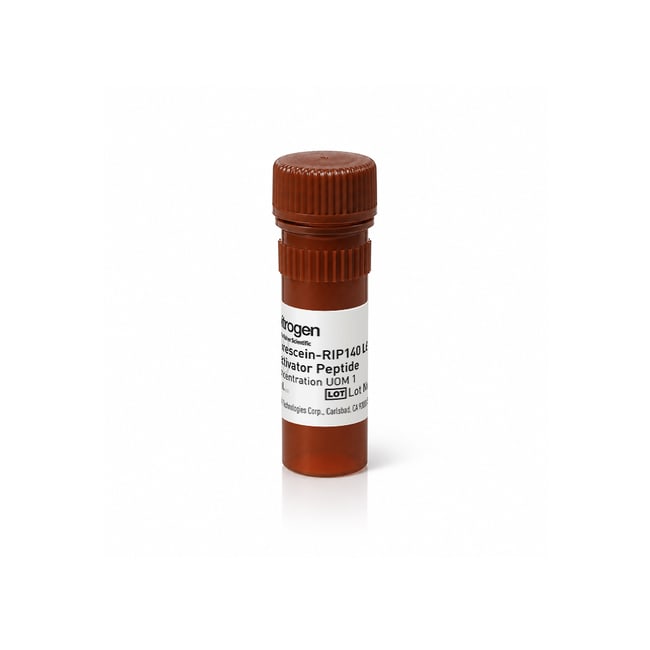
FL - RIP140L6 Peptide, 100μM
Beskrivning
LanthaScreen™ fluorescent nuclear receptor coregulator peptides contain known interaction motifs and are labeled with fluorescein. These peptides are matched and validated to complement the LanthaScreen™ TR-FRET Nuclear Receptor Coregulator Assays. Assays developed using these reagents enable primary or secondary screening of nuclear receptor agonists and/or antagonists.
How they work
Ligand binding to nuclear receptors causes conformational changes in the receptor, resulting in a cascade of events, including dissociation of repressor proteins, association of coactivator proteins, and assembly of pol II and other transcriptional factors for activation of target genes. TR-FRET based assays can be developed using the LanthaScreen™ panel of fluorescein-labeled coregulator peptides to investigate conformational changes of nuclear receptors upon ligand binding, either by determining the affinity of ligand-bound receptor for different coregulator peptides, or by identifying additional agonists or antagonists via displacement or recruitment of a specific coregulator peptide. In the LanthaScreen™ TR-FRET RXR beta Coactivator Assay, a terbium (Tb)-labeled anti-GST antibody is used to indirectly label GSTtagged RXR beta protein. An agonist (9-cis Retinoic Acid) added to the receptor which, upon ligand binding, causes a conformational change resulting in recruitment of the Fl-D22 coactivator peptide (Figure 1). The binding of the fluorescent coregulator peptide to RXR beta causes an increase in the TR-FRET emission ratio (Figure 2).
Contents and Storage:
LanthaScreen™ fluorescent nuclear receptor coregulator peptides are supplied as 100μM solutions in peptide-appropriate buffers. Store peptides at -20°C.
How they work
Ligand binding to nuclear receptors causes conformational changes in the receptor, resulting in a cascade of events, including dissociation of repressor proteins, association of coactivator proteins, and assembly of pol II and other transcriptional factors for activation of target genes. TR-FRET based assays can be developed using the LanthaScreen™ panel of fluorescein-labeled coregulator peptides to investigate conformational changes of nuclear receptors upon ligand binding, either by determining the affinity of ligand-bound receptor for different coregulator peptides, or by identifying additional agonists or antagonists via displacement or recruitment of a specific coregulator peptide. In the LanthaScreen™ TR-FRET RXR beta Coactivator Assay, a terbium (Tb)-labeled anti-GST antibody is used to indirectly label GSTtagged RXR beta protein. An agonist (9-cis Retinoic Acid) added to the receptor which, upon ligand binding, causes a conformational change resulting in recruitment of the Fl-D22 coactivator peptide (Figure 1). The binding of the fluorescent coregulator peptide to RXR beta causes an increase in the TR-FRET emission ratio (Figure 2).
Contents and Storage:
LanthaScreen™ fluorescent nuclear receptor coregulator peptides are supplied as 100μM solutions in peptide-appropriate buffers. Store peptides at -20°C.

Specifikationer
Specifikationer
| Innehåll och lagring | Store in freezer (-5 to -30°C). |
| Etiketttyp | Classic Dyes |
| Kvantitet | 100 μl |
| Frakt skick | Dry Ice |
For Research Use Only. Not for use in diagnostic procedures.
Produkttitel
Genom att klicka på Skicka bekräftar du att du kan bli kontaktad av Fisher Scientific angående feedbacken du har lämnat i detta formulär. Vi kommer inte att dela din information för andra ändamål. All kontaktinformation som tillhandahålls ska också underhållas i enlighet med vår Sekretesspolicy.
Hittar du en möjlighet till förbättring?